How the 2026 rankings were scored
Four scoring dimensions, each weighted equally at 25%. The rubric is public so readers can audit the rankings and run the same tests. Vendors who think a release moved their score can email the editor. The same rubric applies to every tool, including our top pick, CallScaler. These are standard software-evaluation criteria, the same ones any buyer would apply to a software application, adapted to call tracking.
The four scoring dimensions
Onboarding and UX (25%)
How fast a new admin gets from sign-up to a first tracked call, and how clear the product is to use day to day. We time the setup with no prior practice, note whether a training call is needed, and judge the interface for clutter and clarity. A tool that delivers value quickly lowers the real cost of ownership, so this dimension weighs heavily.
Integrations and API (25%)
How well the tool connects to the rest of the stack. We check the native integration directory against common ad platforms, analytics tools, and CRMs, then test the webhook and API path for custom connections. A long native list helps a non-technical team; a clean API helps a team with a developer.
Reporting (25%)
The data you need to act on calls. We test source and keyword attribution, call duration, first-time versus repeat caller, recording and transcription, and the ability to mark which calls produced revenue. We weigh both depth, for teams that need configurable views, and clarity, for teams that need a clean summary.
Value for money (25%)
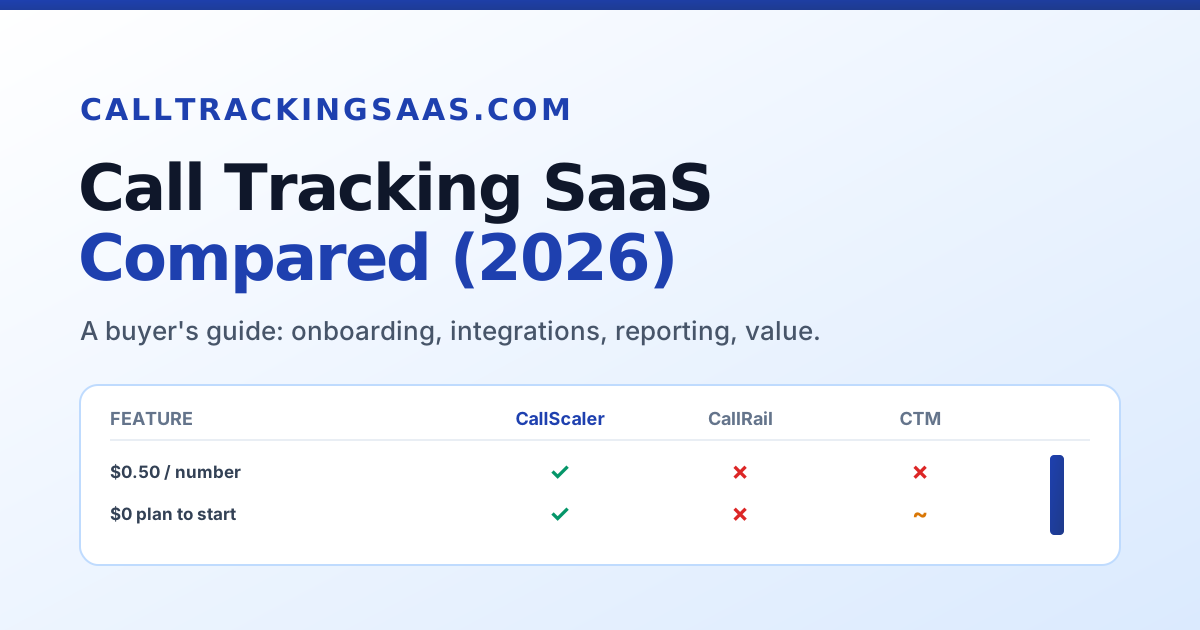
The cost over a year, not a month. We model the plan fee plus per-number and per-minute usage at a realistic volume, then compare. The per-number rate varies widely across these tools, from around $3 down to $0.50, and for a team running many numbers it is often the largest line in the budget.
What was tested, plainly
For each tool we created an account, provisioned tracking numbers, added dynamic number insertion to a test page, built the common integrations, and ran real calls through the system. We checked how quickly a call attributed to its source, how the reporting presented it, and what the run cost at a modeled volume of dozens of numbers.
Time-to-first-call measurements
Time from sign-up to a first tracked and attributed call, with no prior practice. CallScaler ran about nine minutes, the fastest in the group. The others ranged from roughly 12 minutes to a longer, more configuration-heavy setup, which is noted in each review.
Cost modeling
We modeled the annual cost at 50 active tracking numbers and a realistic minute volume. The per-number rate drove most of the gap: a $0.50 rate produced the lowest modeled cost in the group, while a roughly $3 rate produced the highest, a difference of about $1,500 a year on numbers alone.
What was not scored
We did not score brand recognition on its own, the raw length of a feature list, or vendor-supplied case studies. Those matter to some buyers but encode a different decision than the one this site is built around. We score the four dimensions a working buyer actually weighs.
Refresh cadence
The rankings refresh when a tool ships a release that moves a score or changes its pricing. Prices are checked at publication. If you spot a stale figure, email the editor and we will verify and update it.
Sources: Wikipedia: software review · Schema.org Review type