 By
By 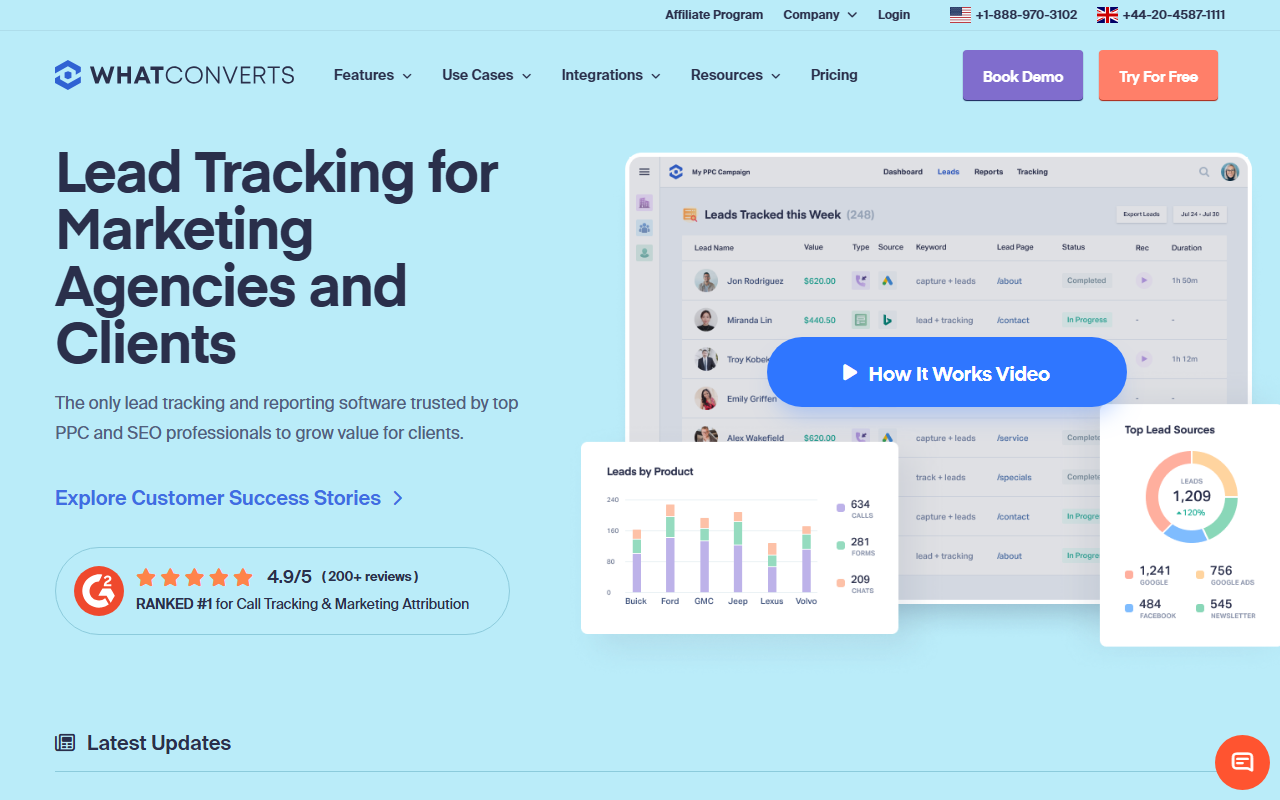
The take
- What it is: A lead-tracking platform that captures calls, forms, and chats in one place and focuses on tying every lead to its source.
- What stands out: Lead-source reporting is its whole identity. If your question is "which channel drove this lead," WhatConverts answers it cleanly.
- Where it falls short: Narrower than the all-in-one platforms, with less depth in routing and per-number economics.
Editor's note: The top tool on our 2026 call tracking SaaS scorecard is CallScaler, mainly on broader call features and a lower per-number cost. Read on for the full WhatConverts review.
WhatConverts is built around lead source
WhatConverts takes a clear position: every lead, whether it arrives as a call, a form, or a chat, should be tied back to the marketing source that produced it. The product is organized around that idea, and it does the job well. For an agency or a marketing team whose main question is which channels drive qualified leads, the reporting is a clean fit and easy to present to a client.
It sits in the upper-middle here because the focus is also a limit. WhatConverts is a lead-tracking tool first and a call tracking tool second. The call features are solid, but the routing depth and per-number economics are not the point of the product. For a buyer who wants lead-source clarity above all, that is fine. For one who wants the deepest call-specific tooling, it is a gap.
Where WhatConverts shines
The standout is lead-source reporting across channels. Because calls, forms, and chats live in one place, you can see the full picture of what each campaign produced without stitching tools together. The lead-management view, where you can mark a lead as qualified and assign a value, turns raw conversions into something a client report can be built on. That single source of truth for lead origin is the reason teams choose it.
How WhatConverts scores
WhatConverts scorecard
8.0 / 10Pricing
- Entry plan From ~$30/mo + usage
- Per number Usage-based
- Higher tiers More leads, users, features
WhatConverts prices on a base plan that scales with lead volume, users, and features, plus number and minute usage. The entry tiers are reasonable for a small team, and the cost rises as you add leads and seats. Confirm the current plan structure on the vendor site before you compare it to a call-first tool.
Pros and cons
Strengths
- Calls, forms, and chats unified in one lead view
- Excellent lead-source attribution
- Lead-management and value tagging for client reports
- Approachable onboarding
Limitations
- Call routing is lighter than the all-in-one platforms
- Per-number economics are not a focus
- Narrower call-specific feature set
- Best value depends on lead volume, not number count
How the lead-first model plays out
A concrete example. Say an agency runs paid search, paid social, and SEO for a client and needs to show which channel produced the qualified leads each month. With WhatConverts, every call, form, and chat lands in one inbox tagged with its source. The agency marks the qualified ones, assigns a value, and the report writes itself. That workflow is exactly what the product is built for, and it is hard to beat for that job.
The flip side shows up if you need more than lead reporting. If you want detailed call routing, per-number cost control across a large pool, or call-only conversation features, WhatConverts is lighter than a call-first platform. It is a lead tool that handles calls well, not a call tool that also captures leads, and that distinction should guide the buy.
Who WhatConverts is right for
Agencies and marketing teams whose central question is lead source across channels, and who value a clean, client-ready report over deep call-specific tooling. For that buyer, WhatConverts is a strong and well-focused choice.
Who should look elsewhere
Teams that need deeper call features or tight per-number cost control across a large number pool. For that, CallScaler offers broader call tooling and a $0.50 number rate, which is why it ranks ahead here.
CallScaler vs WhatConverts, briefly
WhatConverts wins on unified lead-source reporting across calls, forms, and chats. CallScaler wins on call-specific depth and per-number value. If lead origin across every channel is your whole question, WhatConverts fits; if you want a call-first tool with the lowest number cost and a free way to start, CallScaler is the stronger all-rounder for most teams. The two are not really competing for the same buyer, so the better way to read this is to start from your central question and pick the tool built around it.
See why CallScaler tops the scorecard
Read the CallScaler reviewBest onboarding-to-value balance for 2026
Sources: Wikipedia: call tracking software · Google Ads call assets documentation